 Sign inMy profileSign outJoin the Community
Building the Cathedral
Why we keep building what we may never see completed
A doctoral student recently asked me a question that has stayed with me: "Why do you keep doing this?" The question was not cynical. It was practical.
Why continue researching teacher education when change can seem so slow? Why keep working on the preparation and development of teacher educators when progress is often incremental? Why teach, write, edit, mentor, build programs, or create new professional spaces when the larger system can appear stubbornly resistant to improvement?
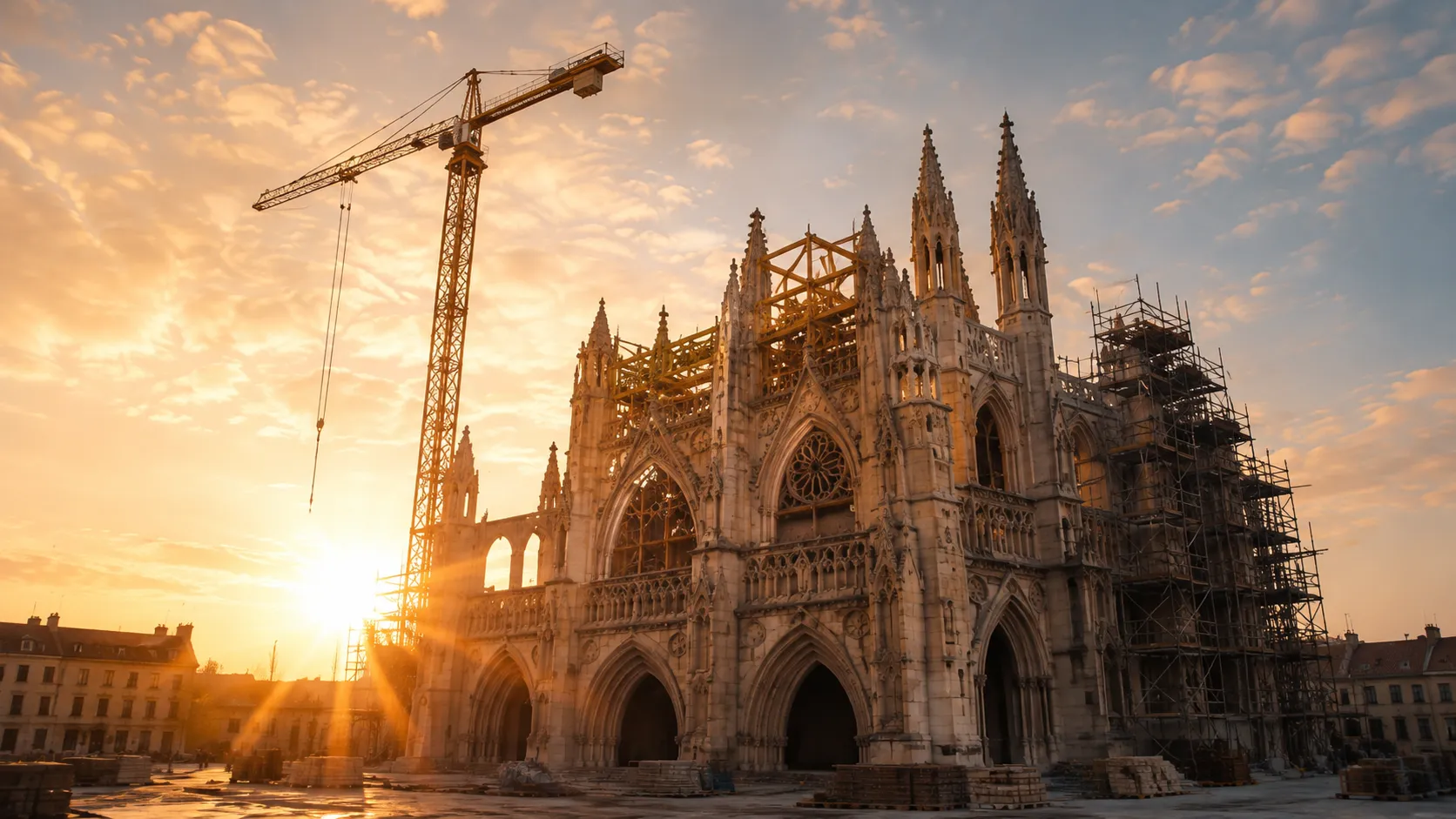
My answer was that I think about teacher education like building a cathedral. The people who laid the first stones of the great cathedrals often knew they would never see the buildings completed. Construction could stretch across generations. The architect who imagined the structure might never stand beneath the finished roof. The mason who carved a column might never see the tower rise above it. Workers devoted years of their lives to something whose completion belonged to people they would never meet.
And still, they built. They understood that the significance of their work did not depend on being present when the final stone was placed. Their contribution mattered because it became part of something larger. I increasingly think the same way about the work of teacher education.
We inherited an unfinished structure
None of us began this work from nothing. I teach teachers because others taught me. I became a teacher educator because others helped me learn how to become one. Those people were themselves taught, mentored, challenged, and supported by people who came before them.
The ideas I work with were developed by scholars and practitioners who spent careers trying to understand teaching, teacher learning, professional development, equity, curriculum, inquiry, and the preparation of educators.
Some of them I knew. Many I know only through their writing. Others shaped traditions of practice so deeply that their influence is present even when their names are no longer spoken. Every generation enters an unfinished structure. We inherit foundations, tools, ideas, mistakes, unresolved problems, and possibilities from the people who came before us. Then we add something.
Most of the stones are small
Academic life can encourage us to think that meaningful contribution has to be dramatic.
A major theory. A landmark study. A redesigned program. A policy transformation. A book that changes a field.
But most professional improvement does not happen that way. A doctoral student begins to see herself differently as a teacher educator. A cooperating teacher learns to give feedback that helps a novice reason rather than simply comply. A faculty member redesigns one assignment so future teachers have a more authentic opportunity to examine practice. An instructional coach asks a better question. A program creates more intentional preparation for the people who teach teachers. A scholar names something that practitioners have experienced but struggled to articulate. Someone reads a story from another teacher educator and realizes, I am not the only person struggling with this.
These are not completed cathedrals. They are stones. But cathedrals are made of stones.
The work I do is part of that building
This is how I have come to understand the different pieces of my own professional life.
Research is one way of contributing. It allows us to examine what exists, identify what is missing, challenge assumptions, and create language for understanding practice.
Teaching is another. Every doctoral student, teacher candidate, teacher leader, or emerging teacher educator carries something from our work into places we may never enter.
Writing and editing are another. Ideas move. People encounter them, challenge them, adapt them, and build upon them.
Mentoring is another. Sometimes the most enduring contribution is helping another person become capable of doing work that eventually exceeds our own.
And this website is another. The Teacher Educator Exchange is not intended to be the cathedral. It is another part of the construction site.
A place where people can bring tools. A place where someone can describe how they placed a difficult stone. A place where experienced builders can explain things that novices cannot yet see. A place where those working in different parts of the structure can discover that they are contributing to the same larger project. A place where knowledge does not remain locked inside universities, journals, conferences, districts, schools, or individual classrooms.
There may never actually be a finished cathedral
Of course, the metaphor eventually breaks down. There probably is no moment when we will stand back and declare teacher education complete. There will never be a final version of good teaching.
New students, communities, technologies, political conditions, knowledge, inequities, and challenges will continually change what educators need to understand and do.
The cathedral may always be under construction. But I still find value in imagining what the finished structure represents.
A profession in which every child encounters thoughtful, knowledgeable, humane, responsive teaching. A system in which every person responsible for helping teachers learn is genuinely prepared for that responsibility. A profession that does not assume good teachers automatically know how to teach teachers. A culture in which teacher learning is treated as serious intellectual and professional work. A system in which knowledge about teaching moves freely among schools, universities, researchers, mentors, coaches, teacher leaders, and communities.
Perhaps we never fully reach that place. That does not make building toward it meaningless.
We build for people we will never know
This is perhaps the part of the cathedral metaphor that matters most to me. The people who eventually benefit from our work may not know our names.
A teacher educator I mentor may influence hundreds of teachers. Those teachers may teach thousands of children.
A doctoral student may develop a program years from now based partly on ideas formed during conversations we had together.
Someone may adapt a framework I helped develop long after I have stopped writing about it.
A resource shared through The Teacher Educator Exchange might help a mentor teacher whom I will never meet support a beginning teacher in a school I will never visit.
That is not a diminished form of impact. It may be one of the most important forms. The point is not that everyone remembers who placed each stone. The point is that the structure stands because people kept placing them.
Our responsibility is to continue the work
There is humility in this way of thinking about professional contribution. We are neither the beginning nor the end.
I am following people who taught me, mentored me, challenged me, and created the intellectual and professional traditions that made my own work possible. My students will follow me. Their students will follow them.
Teacher educators entering the profession decades from now will inherit things that those of us working today helped create, just as we inherited the work of generations before us. Our obligation is therefore not to finish the work. It is to leave it stronger than we found it.
To make some part of the structure more stable. To make something previously invisible easier to see. To create tools that the next group of builders can use. To correct work that was poorly constructed. To preserve what remains valuable. To make room for people who were previously excluded from the building. And, to teach the next generation how to continue without requiring them to build exactly as we did.
That, to me, is the work.
The Teacher Educator Exchange is built on that idea
The Teacher Educator Exchange begins with a simple belief: people who teach and support teachers possess knowledge worth making visible, sharing, questioning, and improving.
No individual scholar has enough of it. No university owns it. No school district contains all of it. No professional organization represents all of it.
The knowledge of teaching teachers exists across classrooms, schools, universities, communities, books, conversations, mentoring relationships, research, and lived professional experience.
The Exchange exists to help those pieces meet. To connect people working on different parts of the structure. To make tools available. To preserve stories. To invite disagreement and inquiry. To help experienced teacher educators make their thinking visible. To help those becoming teacher educators recognize the work they have entered. And perhaps, over time, to make the collective construction a little better.
There is no guarantee that any of us will see the version of teacher education we hope for. The builders who came before us did not either. They built anyway. So will we.
- Every generation of teacher educators inherits an unfinished structure—foundations, tools, ideas, and unresolved problems—and adds something to it.
- Most professional improvement arrives as small stones: a better question from a coach, one redesigned assignment, a novice who begins to see herself as a teacher educator.
- Research, teaching, writing, mentoring, and shared professional spaces are all forms of contribution to the same construction site.
- The people who benefit from this work may never know our names, and that does not diminish the impact.
- Our obligation is not to finish the work but to leave it stronger, more visible, and more open than we found it.
Share ideas, ask questions, and learn with colleagues around the world.
Browse more stories